
Planting Trees to Celebrate the Past and Invest in the Future
In April 2026, Job Carr Cabin Museum commemorated our 25th Anniversary by joining with the community to plant a fruit orchard in Old Town Park. These trees honor Job Carr's legacy of fruit tree cultivation while making an investment toward the future. Only a few months after planting, one of our brand new apple trees produced its first fruit!
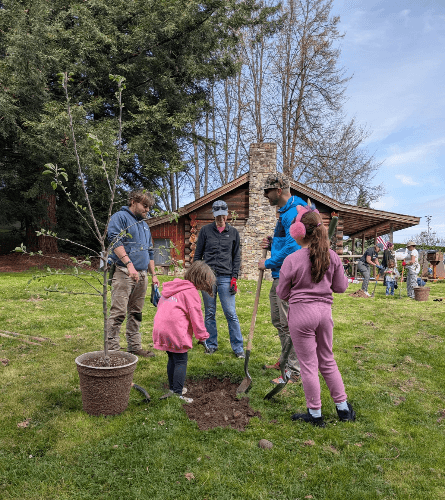
Job Carr Cabin Museum partnered with Parks Tacoma to plant fruit trees in spring 2026 at Old Town Park.
Washington's Native Crabapple
Apple trees are deeply connected to Tacoma's history in many ways. The apple is Washington's state official fruit, and the state currently ranks first in the nation for producing the most apples, pears, cherries, blueberries, and raspberries. Long before settlers introduced cultivated fruit varieties, however, the Pacific Northwest's native Pacific Crabapple thrived.
Pacific Crabapples are a vital and traditional food for many Indigenous groups in the area. In the txʷəlšucid language, the Puyallup people call this tree qaʔxʷac, while the latin name for this plant is Malus fusca. These trees naturally grow in the temperate local climate near sources of water like streams and wetlands. Crabapple trees bloom in spring and fruit in fall. They offered an abundant source of nutrition, along with other heritage plants such as berries, mushrooms, and camas root.
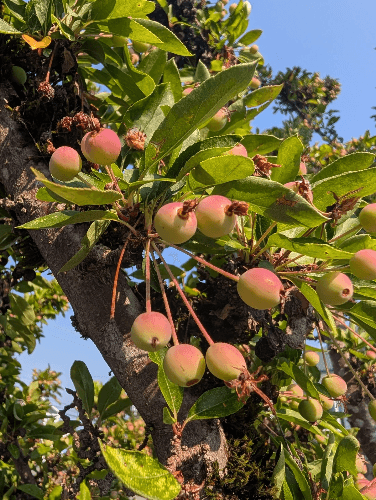
Crabapple trees are planted along the North 30th Street business district in Old Town Tacoma.
Indigenous groups across the region used the crabapple for a variety of different purposes. The Puyallup people—on whose traditional land the Job Carr Cabin Museum now resides—have cultivated and harvested crabapples since time immemorial, using the wood for tools, the bark for medicinal tea, and the fruit as delicious food, raw as well as cooked. Crabapples were traditionally harvested after the first frost, ripened in cattail baskets, and stored in cool, dry places like cedar boxes to preserve the fruit through the winter.
Colonization and displacement led to lost land and livelihoods for Pacific Northwest tribes like the Puyallup, greatly reducing their access to traditional food sources. The Puyallup Tribe and other nearby Indigenous groups, however, are cultivating programs to educate the younger generations and reconnect with their traditional foods.
Job Carr's Fruit Tree Legacy
Soon after settlers started arriving in Washington, they began planting imported types of fruit. Settlers first planted apple trees near Fort Vancouver about 1826 and raspberries near Fort Nisqually in 1833. They used the Pacific crabapple as a pectin source, as well as a pollinator and hardy rootstock for other types of apples.
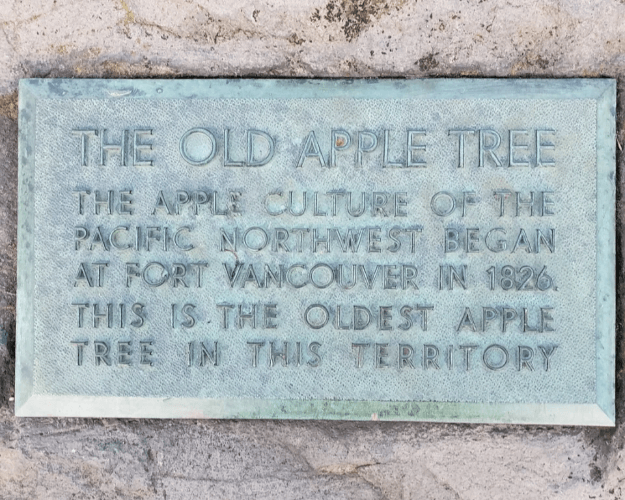
Historic marker near The Old Apple Tree at Fort Vancouver, ca. 2019. While the tree died in 2021, its offspring continue to thrive in orchards nearby.
Job Carr, the first mayor of Tacoma, raised fruit trees before he came west. After his discharge from the Union Army, Tacoma historian Herbert Hunt described how Job bought a nursery in Iowa. “He was something of an expert in apple-growing, and tree pruning." His son Howard records that "Father (Job) attended the meeting of the agricultural society" near Marshalltown, Iowa on March 5, 1864. In the modern era, fruit orchards continue to operate in this part of Iowa.
Although Job owned the fruit orchard for less than a year, the knowledge he gained from this experience came with him when he left for Puget Sound in July 1864. About 1872, Job gave his log cabin to his son Howard and his new daughter-in-law Jane. Meanwhile, Job moved into a farmhouse in Tacoma's North Slope. It was here, while living at 715 North Sheridan, that he planted a new fruit orchard. Job cultivated figs, pears, cherries, and apples. When the North Slope house was demolished in 1920, the property had about 30 apple trees growing strong. To this day, you can still find a few of Job's surviving fruit trees in the North Slope.
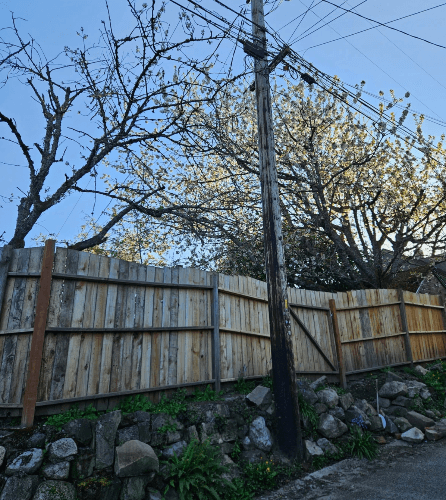
Heritage fruit trees on Job Carr's former property in Tacoma's North Slope neighborhood.
Job Carr's eldest son Anthony also cultivated fruit trees in Pierce County. In the 1890s, a reporter from the Spanaway Sentinel "had the pleasure of viewing A.P. Carr's orchard which is the most substantial he has seen in the state."
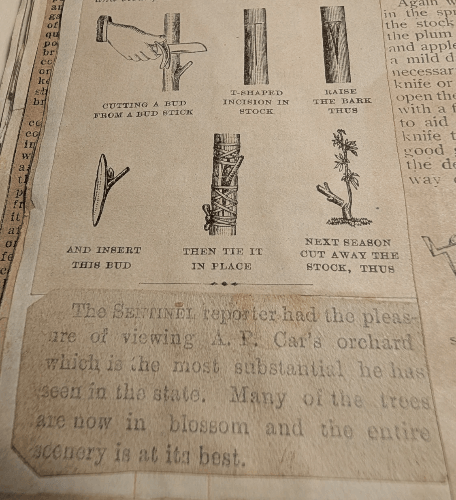
Newspaper clippings from Anthony Carr's scrapbook report on the success of his orchard in Spanaway, Washington and show instructions for fruit tree grafting.
Growing Fruit Trees for the Next Generation
There are many garden plants that provide food quickly: potatoes, carrots, and peas can all be harvested within a few months of planting. Fruit trees, however, do not produce results overnight. They are a long-term investment that require consistent, diligent care. Apples produced from grafted trees usually take 2-5 years to produce a full harvest, while trees planted from seed may require 10 years or more. Both the Puyallup people’s careful tending of crabapples and Job Carr’s establishment of his North Slope orchard go beyond simply finding a way to fill one’s belly for a season; they chose this place for their home and invested in these trees as their legacy. In so doing, each provided those who would come after them with more apples than they could harvest in their own time.
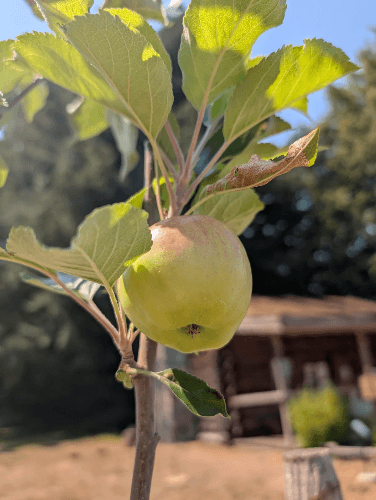
First apple on the newly planted trees at Job Carr Cabin Museum in Fall 2026.
Crabapple trees still provide the Puyallup people with medicine and food today, and a few trees of Job’s orchard continue to thrive in the North Slope neighborhood of Tacoma. While it will still be some time before the fruit trees at Job Carr Cabin Museum mature, each sapling is an investment toward the future and will grow to provide shade, clean air, and many more fruits to share with our community.
Fruits of the Land Webinar
In April 2026, Job Carr Cabin Museum partnered with Tacoma Tree Foundation to host a webinar about the history and symbolism of the apple tree in Washington. In this video, agricultural historian Josiah Pollock, Puyallup Tribal Sustainability Director Kalicia Bean, and Pierce Conservation District's Chris Madden each shared their perspective on what we can learn from the history and current cultivation of the Pacific crabapple and cultivated apple trees in our region.
About the Author
Emma Fleming completed an internship with the Job Carr Cabin Museum during the summer 2026. She graduated from the University of Washington with a Bachelor Degree in Anthropology focused in Indigenous Archaeology, as well as a minor in Education. After her internship, she will be attending university in Germany to study language, literature, and culture for her Masters Degree. Her dream is to use her experience in foreign language, education, and anthropology to building programs that connect museums with their communities and with other cultural institutions around the world.