
This multi-part blog series discusses important Black figures in early Tacoma history. It underscores theircontributions to the city’s history. These men and women helped shape and develop Tacoma, providing lasting impacts that can still be seen today.
The first article is about the Conna family who were the among the first Black families to live in Tacoma and is available here.
This second article is about George Putnam Riley who was the leader of the first Black land investors in Tacoma.
The third article is about Nettie Asberry, a leading Black voice in Tacoma history and will be available soon.
George Putnam Riley
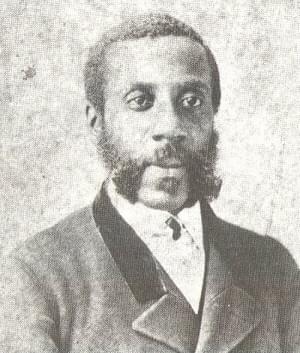
Photograph of George Putnam Riley
George Putnam Riley was the leader of the first Black land investors in Tacoma. Born in Boston in 1833, George's father owned a clothing store. His grandfather fought and died in the Revolutionary War under American General Israel Putnam. In the 1800s, George's parents William and Elizabeth were both active abolitionists in Boston. They raised money for progressive causes, including William Lloyd Garrison's newspaper The Liberator, and assisted at least one fugitive slave by hiding him in the attic.

The Liberator was a radical abolitionist newspaper published in Boston, Massachusetts 1831-1865. Title from the inaugural issue from the archives of the Library of Congress.
While George attended public school, like many African Americans in the 19th century he was prevented from attending university because he was Black. As a youth, he worked for Benjamin Butler, a prominent attorney, politician, and later a major general in the US Civil War. About the time of his mother's death in 1855 when George was in his early twenties, he decided to head west. Attracted by the allure of gold, he first traveled to San Francisco, California and then to Victoria, BC. In both locations, he worked as a barber and was involved with anti-discrimination efforts.
After the U.S. Civil War ended, George travelled through Washington and Oregon before returning to Massachusetts. There he met and married Harriet Gordon and they had one daughter Bonita. Although Oregon had a reputation as a place where Black people were discouraged from settling, George decided to take a chance and return to the west. In early 1869, he set out for Oregon; his family arrived later. In Portland, George began working as a barber but soon looked for bigger opportunities. In December 1869, he became president of the Workingman's Joint Stock Association (WSJA). This coalition of Portland land investors was made of twelve Black man, two Black women, and one white man. Washington was an appealing place for land investment since it did not have a history of exclusionary laws and Jim Crow policies.
With George's leadership, the association invested in land between Seattle and Tacoma. Their first purchase was for property in Seattle, which later became part of the Beacon Hill neighborhood. In 1870, they bought 67 acres of land in Tacoma, known as the Alliance Addition. The land was situated outside of the central business district in the neighborhood we now call Hilltop. The property roughly extended from S M Street to Sprague Avenue east to west, and from S 9th Street to S 12th Street north to south. George pushed to get the Alliance Addition incorporated into the city after facing legal issues with squatters.
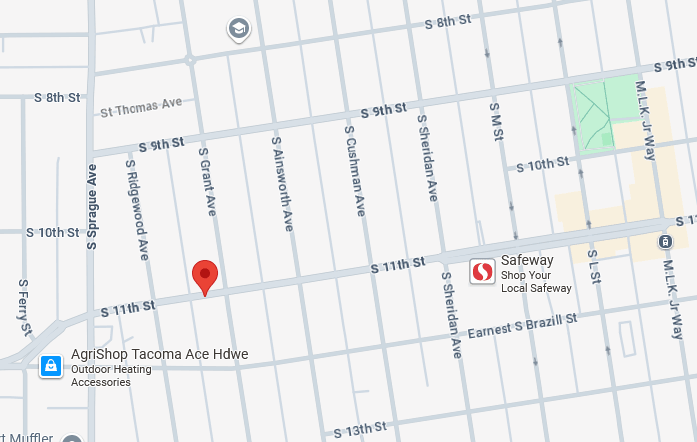
Google Map showing the general area of the Alliance Addition in Tacoma's Hilltop neighborhood. The later location of the Riley family home is marked at 1706 S 11th Street.
George and his family continued to live in Portland. In addition to his real estate investments, he continued working as a barber and was employed for several years at the U.S. Customs House. He was politically active and renowned as a skilled speaker, frequently taking the stage to speak about civil rights at public events.
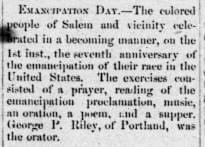
Announcement for Emancipation Day celebrations in Salem, Oregon including an oration by George P. Riley of Portland. Published in the Weekly Pacific Tribune on Jan. 22, 1870.
In 1887, the Riley family moved north to the Alliance Addition property in Tacoma. Although a few members of the WSJA moved to their Seattle properties, George is the only one to have lived in Tacoma. Their home was located at 1706 S 11th Street, in a neighborhood that would later become the heart of Tacoma's Black community. Here, George continued his political activism. He regularly spoke at the Tacoma Emancipation Day celebrations. In the 1894 election, he was affiliated with the Populist Party but in 1904 was elected as a delegate to Tacoma's Republican Convention.
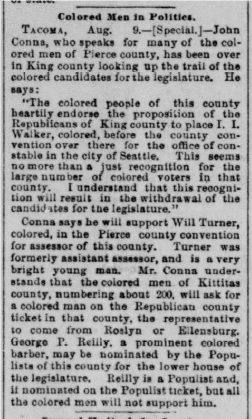
An article titled Colored Men in Politics reported that John Conna was supporting Republican candidates while George P Reilly (sp. Riley) was expected to be nominated for the legislature with the Populist Party. Published in the Seattle PI on Aug. 10, 1894.
His wife Harriet passed away in Tacoma in 1896 and George died here in 1905. They are buried in the Tacoma Cemetery along with their daughter. According to his obituary in the Tacoma Daily Ledger, he was very influential in the Pacific Northwest. "... Mr. Riley was always identified with the most prominent men of the Pacific Coast and numbered among his friends a great many of the most influential citizens of the Western country." George Riley saw the potential in Tacoma when he invested in the city, and through his relentless advocacy, continued to push the community to strive for the promise of equal rights.
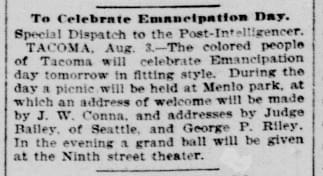
Announcement about the Tacoma Emancipation Day celebrations featuring J. Conna and George P. Riley. Published in the Seattle PI on Aug. 4, 1897.
About the Author
Charlee Dobson Cohen completed an internship with Job Carr Cabin Museum in summer 2025 as a junior at University of Puget Sound majoring in History and Art History and minoring in African American Studies and Study of Consciousness. With this, she hopes to go into curatorial work in museums.