
How Two Tacomas Became the City of Destiny
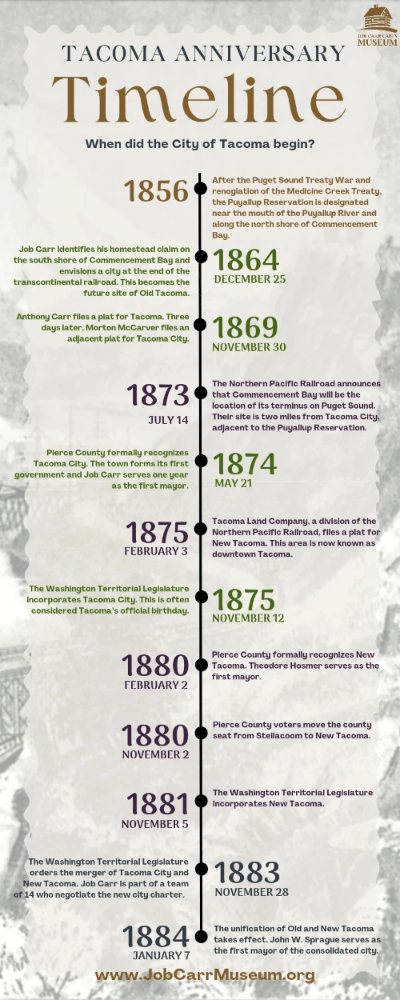
The Puyallup People traditionally lived in multiple villages spreading from the base of təqʷuʔmaʔ / təqʷuʔbəd (Mt. Rainier) to the Puget Sound. Following the 1854 Medicine Creek Treaty and the Puget Sound Treaty War, the Puyallup Tribe was assigned a reservation near the mouth of the Puyallup River. When Job Carr arrived in 1864, he selected a homestead claim about 3 miles away from the Puyallup Reservation boundary. He imagined the possibilities for a major city and hoped that the Northern Pacific Railway (NPRR) would agree this was the perfect location for their western terminus. Over the next 20 years, however, the area became a contested landscape where different factions pursued competing visions for Tacoma’s future.
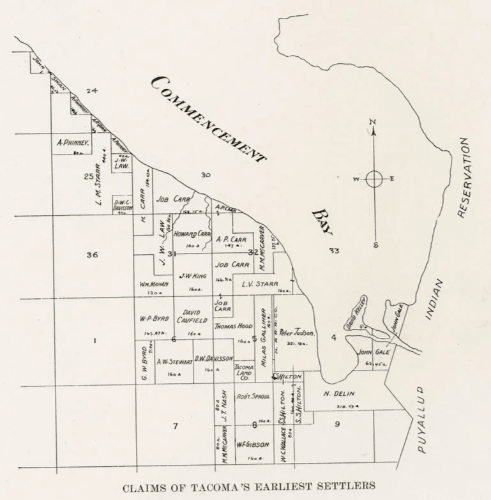
Plot map of Tacoma land claims in 1868. A reproduction of this map is on display at Job Carr Cabin Museum. It also appears in Puget's Sound by Tacoma historian Murray Morgan.
Two Tacomas on Commencement Bay
Job's arrival on Commencement Bay inspired his sons Anthony (1865) and Howard (1866) to do the same. A few years later, Morton Matthew McCarver arrived and purchased most of Job’s land. McCarver was a land speculator who made grand promises about his ability to bring development and gain the attention of the NPRR executives. What could have been a good match -- the visionary Carr and the promoter McCarver -- instead turned into a family rivalry. According to Job, the trust he placed in McCarver was immediately betrayed as McCarver began to claim sole credit for starting town. Both families wanted to be recognized as town founders, but McCarver was not interested in sharing the spotlight.
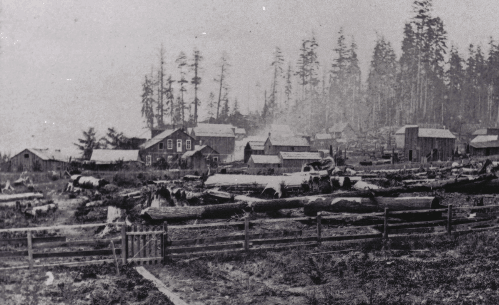
View of Tacoma looking east, circa 1868. Job Carr's cabin is visible on the left of the photo near the shoreline.
The Carr family took several leadership roles in the fledgling town. In March 1869, Job was appointed the settlement's first post master; and Anthony Carr worked as the town's first postal carrier. Job's log cabin served as the first post office and as the first polling place where 53 local men voted for a congressional delegate. On November 30, Anthony filed a plat at the auditor’s office in Steilacoom for a town named “Tacoma,” an interpretation of the txʷəlšucid (Twulshootseed) word təqʷuʔməʔ / təqʷuʔbəd.
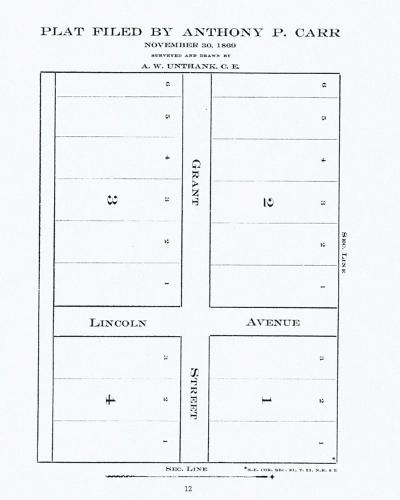
Anthony Carr's Plat Map for Tacoma, filed on November 30, 1869 with the Pierce County auditor's office in Steilacoom.
Although Morton McCarver had drawn up a proposed plat a few months earlier on waterfront land, he failed to submit the documents in a timely manner. He arrived at the auditor's office three days after Anthony. His initial choice for a town name was Commencement City but friends encouraged him to change his mind to “Tacoma City.” With his business savvy and investment backers, McCarver began selling off sub-plots of land and his plat was realised as the new city's street grid. The 1870 census recorded the population of Tacoma City at 73 people.

View of Tacoma looking west, circa 1871.
Meanwhile, the Northern Pacific Railway (NPRR) had its own plans for Commencement Bay. In 1873, the railroad formed the Tacoma Land Company. They purchased more than fifteen thousand acres of undeveloped land southeast of Tacoma City, adjacent to the recently surveyed Puyallup Reservation. On February 3, 1875, the Tacoma Land Company filed a plat for "New Tacoma." They began heavily promoting this separate waterfront settlement in contrast to the older Tacoma City. Although Tacoma City had been around for less than a decade, it soon became known colloquially as "Old Tacoma."
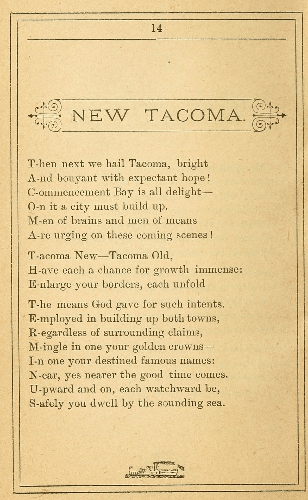
An ode to New Tacoma, published 1893. From the Library of Congress archives.
Official Recognition
While Carr and McCarver were disappointed that they were left out of the railroad's plans, they did not give up hope for Tacoma City. In 1874, more than a hundred residents petitioned for “Tacoma City” to form a municipal government. The town gained official recognition from Pierce County on May 21. Job Carr was elected days later as the first mayor. He helped address the problems that faced the small town, such as dogs and hogs running rampant, disorderly conduct disturbances, and the need for better city streets. His son Howard served several terms as the town Marshal.
McCarver also held public leadership roles. In 1870, he was elected as county superintendent of public schools. By 1873, he was also serving as road supervisor. But McCarver did not live long enough to see what is widely considered the city's official birthday. He passed away in April 1875 a few months before the Washington Territorial Legislature passed a special act “to Incorporate the City of Tacoma” on November 12, 1875.
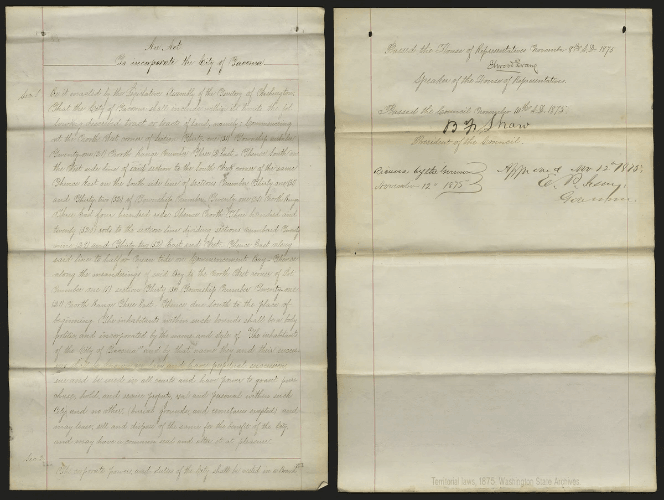
Legislation from the Washington Territorial Legislature to incorporate the City of Tacoma, signed by Government Elisha P. Ferry on November 12, 1875. From the Washington State Archives.
Meanwhile, New Tacoma's future was bright with the arrival of the transcontinental railroad. Construction was booming with new buildings, warehouses, and docks connecting rails to sails. The town sought its own official recognition. New Tacoma was granted incorporation by the Pierce County Commissioners on February 2, 1880. Two days later, Theodore Hosmer was elected as the first mayor. He was General Manager of the Tacoma Land Company, oversing the local real estate of the NPRR. Early meetings of the New Tacoma city council passed ordinances preventing drunkenness and disorderly conduct, prohibiting the use and carrying of deadly weapons and the discharge of firearms, preventing swine running at large, providing fire protection, and regulating theatrical and other exhibitions.
Further enhancing the community's status, Pierce County residents voted to move the county seat from Steilacoom to New Tacoma on November 2. To lure this relocation effort, the Tacoma Land Company offered free rent to the county offices for a year and donated land for a new county courthouse. The territorial legislature followed up by passing a special act on November 5, 1881 “to Confer a City upon New Tacoma.”
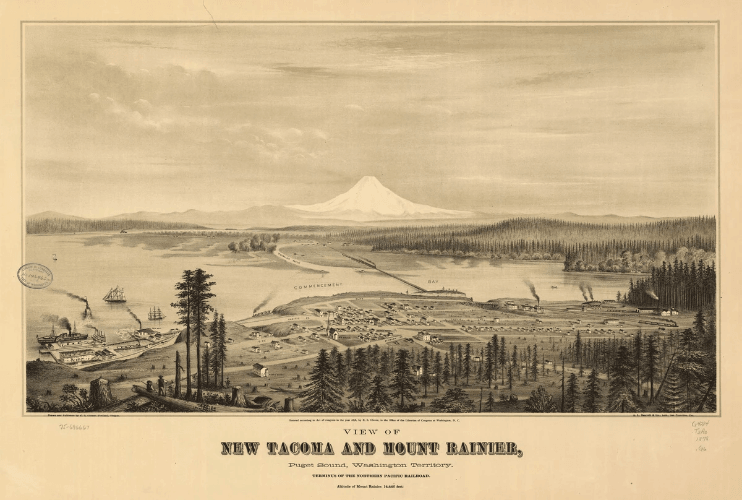
1878 sketch of New Tacoma and Mount Rainier, from the Library of Congress archives
Both Tacoma City and New Tacoma were now officially on the record. They maintained their own identities, industries, and governments. They collected their own tax funds for schools, roads, and other public services. There was only a dirt trail through the forest connecting the two towns, so most travel and trade was via mosquito fleet ferries. A smallpox outbreak in 1881 in New Tacoma highlighted the division between the two towns; officials in Tacoma City successfully cut off all interactions for two months, preventing the disease from spreading.
Merging Two Towns Together
By 1883, the population of New Tacoma at 4,000 people was about ten times larger than Tacoma City. Representaties from New Tacoma proposed to combine the two cities. Opposition from the Tacoma City faction, however, initially defeated the measure. While Old Tacoma did not benefit from the railroad and banking investments of New Tacoma, it had a strong sense of identity, influential business owners, and a well-regarded municipal government. Disputes over taxation, public services, and the future of Tacoma continued.
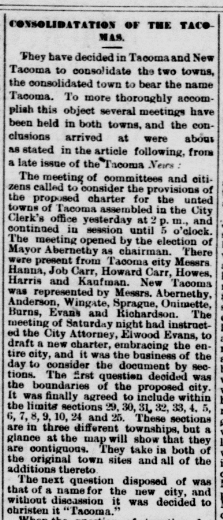
News report about a proposed merger between Tacoma City and New Tacoma. "Consolidations of the Tacomas" published October 21, 1883 in the Seattle Post-Intelligencer.
Job and Howard Carr were part of a 14-member commission that first met on October 14 to begin negotiating a charter between the competing cities. The commission debated how to structure the new government and how to represent the interests of various neighborhoods. Tacoma City residents were worried about the possibility of losing their post office, school district, and road funds in the merger. With a smaller population than New Tacoma, Old Tacoma did not want to lose its voice.
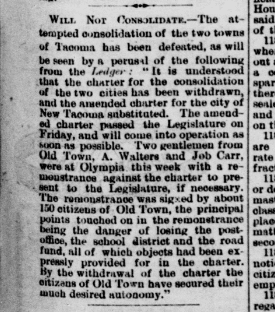
News report about the breakdown in negotiations between Tacoma City and New Tacoma. "Will Not Consolidate" published November 7, 1883 in the Seattle Post-Intelligencer.
One of the people opposed to the merger was John Nash Fuller. To overcome his objections, he was appointed to fill a vacancy on the Tacoma City Council on November 5, 1883. Two days later he received the rights for the city water works. The following week, he no longer opposed the merger of the two Tacomas and the consolidation process began to move forward again.
Job Carr, serving as a representative of Tacoma City, was nominated to travel to Olympia with the new amended charter “and to use his best endeavors to get it passed this Legislature.” On November 28, 1883, territorial lawmakers approved a new bill to unite the two Tacomas. The law detailed the structure of the city's government, including boundaries, elections, and debt limits. Tacoma City would become the First Ward district, while New Tacoma would be represented by the Second and Third Wards.
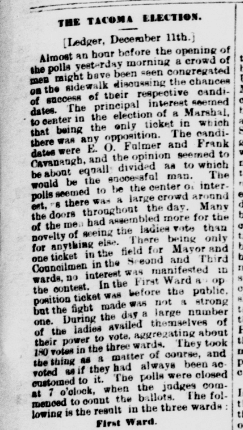
News report about election for the consolidated Tacoma. "The Tacoma Elections" published December 12, 1883 in the Seattle Post-Intelligencer.
On December 10, residents of both towns, including 191 women, cast their ballots for the leadership of a unified Tacoma. They overwhelming selected General John W. Sprague as interim mayor. The First Ward representatives included Howard Carr, John Nash Fuller, and mill owner George Atkinson. Tacoma's new government would take effect at the start of the new year.
Before the merger went into effect, the Tacoma City leaders had to decide what to do with their surplus bank account. After paying all their debts, the town still had $250 available. The newspaper reported that they planned to have a celebration, rather than letting the money disappear into the new municipal coffers. The council proposed chartering a boat to Seattle where they could enjoy a banquet and attend to the theater. More practical considerations prevailed, however, when the officials decided to purchase fire hoses instead.
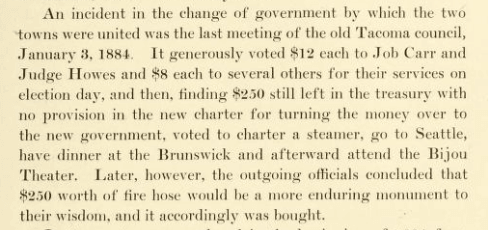
A summary of closing out the Tacoma City government before merging with New Tacoma. "Tacoma, its history and its builders" p311, by Herbert Hunt, published 1916.
One City of Tacoma
On January 7, 1884, Tacoma was officially incorporated as a single city. General John Wilson Sprague's interim term as mayor lasted until May overseeing the transition period for the two towns. One of their first orders of business was to fund construction of a new building to serve as prison and fire station. Despite the merger, divisions remained between Old Town and Downtown Tacoma. The fortunes of Downtown, and later South Tacoma, were closely aligned with the boom and bust cycles of the railroad, while Old Town was more strongly tied to the lumber mills, boat shops, and fishing fleet centered on its waterfront. Gradually, the First Ward’s political capital waned as the city continued to grow. Its industrial core also shifted when the creation of the Port of Tacoma in 1918 enticed businesses away from Old Town.
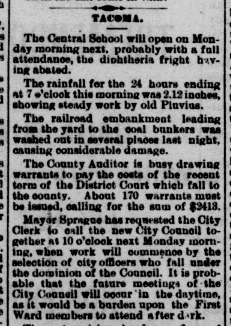
News report about incoming Mayor Sprague's request for the new City Council to begin meeting. "Tacoma" published on January 6, 1884 in the Seattle Post-Intelligencer.
After the merger, the Carr family began to drift toward other endeavors. Job Carr temporarily relocated to Olympia through 1885. Anthony Carr had already moved to a farm in Spanaway. Howard Carr was re-elected as a Tacoma city council member in May 1884 but resigned days later; a few years later he moved to Yakima.
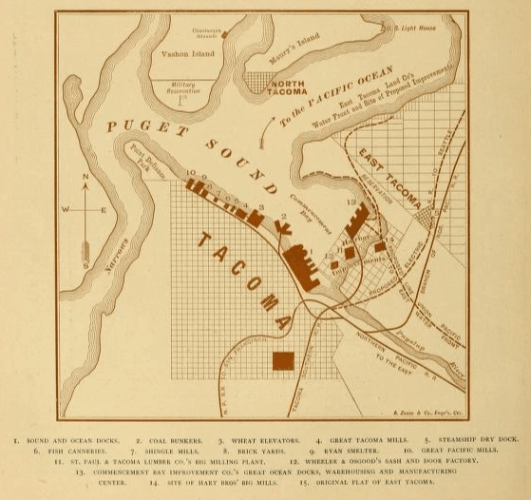
Map of Tacoma showing the industries along the Commencement Bay waterfront, the railroad, and the Puyallup Reservation, published in Tacoma Illustrated, 1889
One of the biggest changes to finally bring all residents of Tacoma together was the construction of Tacoma Avenue in 1889. This roadway also served as the city's first streetcar route, connecting the longtime rival communities. Now, travel between Old Town and Downtown was convenient and easy. People became less tied to a single Tacoma neighborhood. They could live in one neighborhood, commute to another for work, and visit other neighborhoods for shopping and recreation. Gradually, the First Ward’s political capital waned as the city continued to expand. Old Tacoma's industrial core also began to move away with the creation of the Port of Tacoma in 1918.
Tacoma became know as the City of Destiny, but from the start many had different visions of how that destiny would play out. From the Carrs and McCarvers, to the railroad company, to other town leaders, each had their own take on how and where the city should develop. The competition between Tacoma City and New Tacoma fostered a fierce local pride, and influenced Tacoma's character for decades.
About the Author
Kamiyah is a sophomore at Occidental College majoring in politics and minoring in media, arts, and culture. She chose to intern with Job Carr Cabin Museum to connect with the North Tacoma community, while also learning about Tacoma and Washington's unique history through archival research projects.